Geothermal Power Plant Impact of Scale and Corrosion
According to an April 2021 report by Global Industry Analysts, the global geothermal energy market is expected to reach US $8.9 billion by 2027, up from US $4.7 billion in 2020, with the US market estimated at US $1.4 billion in 2020.
Geothermal energy systems fall into three categories, as outlined by the US Energy Information Administration:
Direct use and district heating systems
Geothermal power plants
Geothermal heat pumps
This paper is focused on corrosion and scale control in the geothermal power generation market.
Geothermal power plants are categorized as the following:
Dry Steam – harnesses steam produced naturally in the geothermal reservoir
Simplest and oldest
Image Source: U.S. Department of Energy
Flash Steam – converts high-pressure hot groundwater to steam
Most common
Image Source: U.S. Department of Energy
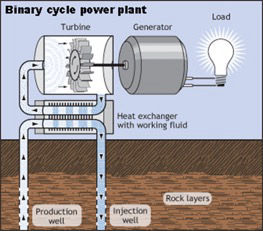
Binary – uses geothermal hot water as the heat source to turn a secondary liquid to steam
Most recent design
The market for dry steam plants is estimated to grow by 8.4% CAGR to US $2.4 billion by year’s end 2027. Binary plants will have a projected 8.8% CAGR. The flash steam segment is expected to see a 10.6% CAGR propelled by growth in the USA, Canada, Japan, China, and Europe, developing from an estimated US $2.1 billion regional market share in 2020 to US $4.3 billion in 2027, with China growing at the fastest rate. Asia-Pacific leaders for the flash steam sector will include Australia, India, and South Korea (US $1 billion regional forecast for 2027).[1]
At the end of 2020 there were 522 geothermal plants operating worldwide.[4] As of 2019 there were 43 operating geothermal plants in California with the highest percentage in the Geysers complex north of San Francisco.[5] California has two proposed sites: Hell’s Kitchen (2023) and Casa Diablo IV (2021).[6] After California, Nevada is the second largest geothermal producing state in the U.S.
A Transparency Market Research (TMR) report indicates a promising decade ahead for geothermal power, thanks to changes in attitudes about fossil fuels and an increasing focus on renewable energy, even among governments. The quest to reduce carbon footprints has become an encouragement for companies to fall back on geothermal energy. Despite the challenges to attracting investors due to high initial investments and delayed ROI, TMR expects the value of geothermal power equipment to steadily grow to approximately US $32 billion by year’s end 2027.[10]
The steam and/or hot water from geothermal wells are high in corrosive elements such as chlorine, hydrogen sulfide, sulfuric acid, carbonic acid, and ammonia. The presence of these elements leads to the following types of corrosion within a plant: uniform corrosion, pitting corrosion, stress corrosion cracking, and sulphur stress corrosion cracking. Hydrogen bubbling and scale formation can also occur. Common types of scale in a geothermal system are calcium carbonate, heavy metal sulphides, and silica or metal-silicates. Corrosive elements in the steam and/or hot water attack the surfaces of the production and injection well casings, steam turbine flow path, and heat exchangers for binary systems. The corrosive gases emitting from the steam/hot water attack the infrastructure (steel and concrete), the external surfaces of machinery, and the electrical control systems (e.g., control panels, junction boxes, motor control centers, and motors). The following materials and methods are suggested to minimize the impact of these harsh geothermal conditions.
Prevention of Scale and Corrosion in Well and Turbine:
Inject scale and corrosion inhibitor into the production well
Inject scale and corrosion inhibitor into the discharge from the steam turbine
Coat turbine blades and casing internals with VpCI®-396 Carbide
Use S-15
Protection of Operational Systems:
Lubrication systems
Add M-528, M-530, M-531 at 2%-5% by weight
Electronics/electricals
Install Emitters
VpCI®-101 Device, VpCI®-105 Emitter, VpCI®-111 Emitter, VpCI®-308 Pouch
Apply ElectriCorr™ VpCI®-239
Threaded assemblies such as valve stems and packing body bolts
Apply VpCI® Super Penetrant
Exposed machined surfaces
Coat with VpCI®-391 or EcoShield® 386 Clear
External painted surfaces – choose from the following coatings:
VpCI®-386 HT for turbines and other equipment that reach 750 °F (399 °C)
VpCI®-371 for surfaces that reach 1250 °F (677 °C)
VpCI®-386, VpCI®-387, VpCI®-384, VpCI®-375 for non-submerged external surfaces below 350 °F (177 °C)
To optimize coating selection, it is recommended that a sample of any fluid that will be in contact with the surface be sent to Cortec® lab for analysis
Under insulation
Apply VpCI®-658, VpCI®-619
Transformer oil
Add M-236
Generators
Place VpCI®-308 Pouch inside generator housing
Steam system
Inject Corrosorber® liquid into the production steam at the wellhead
Dose rate to be calculated by Cortec® lab based on CO2 and H2S content
Cooling water system
Inject Corrosorber® liquid and VpCI®-647 into the condenser hotwell.
Dose rate to be calculated by Cortec® lab based on CO2 and H2S content
Equipment Shutdown and Layup:
Turbines
Steam side
Fog with VpCI®-337 at 3-0.5 oz./ft3 (0.31-0.52 L/m3)
Oil side (if M-528, M-530, M-531 is not used during operation)
Fog bearing housings, supply and drain lines, and oil sump with M-528, M-530, M-531 at 0.3-0.5 oz./ft3 (0.31-0.52 L/m3)
Generators
Oil side (if M-528, M-530, M-531 is not used during operation)
Fog bearing housings, supply and drain lines, and oil sump with M-528, M-530, M-531 at 0.3-0.5 oz./ft3 (0.31 -0.52 L/m3)
Electrical side
Spray all electrical contacts with ElectriCorr™ VpCI®-239
Install appropriate emitters in junction boxes, control panels, enclosures, and generator housing
Switchgear
Remove any rust with VpCI®-422 or VpCI®-423, followed by VpCI®-414
Prime all surfaces to be painted with CorrVerter® Rust Converter Primer
Topcoat with VpCI®-396
Spray all contacts with ElectriCorr™ VpCI®-239
Install appropriate emitter
Transformers
Remove any rust with VpCI®-422 or VpCI®-423, followed by VpCI®-414
Apply CorrVerter® Rust Converter Primer to all surfaces that will be painted
Topcoat with EcoShield® 386
Spray all contacts with ElectriCorr™ VpCI®-239
Install appropriate emitter
Pumps (excluding oil)
Flow path
Fog with VpCI®-337 at 0.3-0.5 oz./ft3 (0.31-0.52 L/m3)
Oil side (if M-528, M-530, M-531 is not used during operation)
Fog bearing housings, supply and drain lines, and oil sump with M-528, M-530, or M-531 at 0.3-0.5 oz./ft3 (0.31-0.52 L/m3)
Pumps (oil)
Flow path
Fog with M-528, M-530, or M-531 at 0.3-0.5 oz./ft3 (0.31-0.52 L/m3)
Oil side (if M-529 is not used during operation)
Fog bearing housings, supply and drain lines, and oil sump with M-528, M-530, or M-531 at 0.3-0.5 oz./ft3 (0.31-0.52 L/m3)
Piping (oil)
Fog with M-528, M-530, or M-531 at 0.3-0.5 oz./ft3 (0.31-0.52 L/m3)
Piping (non-oil)
Fog with VpCI®-337 at 0.3-0.5 oz./ft3 (0.31-0.52 L/m3)
Cooling water system
Option 1:
Set up jumper system between condensate injection and condensate inlet to condenser
Add between 0.3-1.0% by weight VpCI®-649 to the condensate and circulate for 24 hours
Drain or leave wet
If system is drained, place Cooling Tower Frog® water soluble bags in the designated cooling water components
Option 2:
Set up jumper system between condensate injection and condensate inlet to condenser
Fog with VpCI®-337 at 0.3-0.5 oz./ft3 (0.31-0.52 L/m3) into the condenser and all pumps and piping
It may be necessary to isolate certain parts of the system and create a small pressure drop to increase the travel of the VpCI®-337
General Maintenance and Repair:
Clean all rusted exterior surfaces with either VpCI®-423 or VpCI®-422
Neutralize with a 10% solution of VpCI®-414
Clean all exposed machined surfaces with a 10% solution of VpCI®-414
Coat with VpCI®-391
Spray all threaded assemblies such as valve stems, packing body bolts, and fasteners with VpCI® Super Penetrant
Repair any painted surfaces with the appropriate Cortec® coating
For a entire version please click here.